
Freedom Fighters with Leopoldo López
The Midnight Foundation presents Freedom Fighters, a four-part docuseries featuring Venezuelan opposition leader and democracy campaigner Leopoldo López. The series tracks Venezuela’s descent into autocracy, exploring the human cost of opposing centralized power and what it takes to defend fundamental rights.
When the social structures, institutions, and technologies that enable people’s freedoms are dismantled, the battle moves online just as much as it happens in physical spaces. Autocratic regimes and hostile actors will exploit whatever channel they can, making it critical to build tools that give people back control over their digital lives. The future of freedom now depends directly on the digital infrastructure built to protect it.
Defending against networked autocracy requires freedom technology that preserves people’s ability to communicate, transact, and organize with privacy and autonomy. This documentary aligns with the Midnight Foundation’s mission to protect personal data and support digital freedom. López’s experience in Venezuela reveals the real human consequences of this conflict, proving exactly why building secure infrastructure is essential. Watch all four films at midnight.network/freedom-fighters.
Midnight network roadmap
The latest roadmap for the Midnight network is now live, outlining technical milestones across seven core tracks through the first quarter of 2027. The schedule focuses on making programmable privacy practical on-chain, covering key areas such as confidential financial infrastructure, verifiable identity tools, network scaling, and post-quantum proving systems.
Key updates introduce enterprise key support for institutional tokenization, a staged migration to the BABE consensus protocol, and new developer tools including mobile SDKs and AI coding assistants. Learn more about what’s coming up at midnight.network/roadmap.
Applications
At TOKEN2049 Singapore, Midnight President Fahmi Syed provided a high-level view of the expanding ecosystem and capabilities, explaining how the Midnight network solves the transparency issues inherent to public blockchains. The presentation included brief technical demos of the Collateral Warehouse, which shields cross-chain market deposits, and Offer Files, which execute private, single-step trades without exposing users to front-running.
Speakers from across the Midnight ecosystem showcased functional progress:
- Midnight Companions introduces privacy-preserving AI agents that connect users with relevant applications. Companions provide personalized trading insights and ecosystem recommendations without exposing underlying user data.
- Midnight Passport provides a user-friendly application to control digital identities and assets. Midnight Passport allows users to execute transactions via private aliases and delegate specific on-chain permissions to AI agents while maintaining absolute custody of their funds.
- Nightmode with SIG Network extends Midnight's cryptographic privacy directly to Ethereum. By deploying shielded vaults, developers can build private versions of decentralized finance protocols like Uniswap and Aave without forcing users to navigate traditional bridges.
Input Output Founder Charles Hoskinson shared the vision for Midnight City, as a self-sovereign simulation for autonomous AI agents to battle-test cross-chain trading, identity, and commerce. He also introduced the concept of Nightframes, a context-aware, privacy-focused successor to standard smart contracts.
Ecosystem Updates
Developments across the Midnight ecosystem expand Midnight functionality across new chains, and the latest hackathon in Korea showcases privacy-enhancing apps using Compact.
Sig Network upgrades and expansion
Sig Network released versions 0.24.0 and 0.25.0 of its Midnight integration, modifying how its multi-party computation (MPC) signs outputs, expanding functionality to Solana. The integration enables Midnight contract execution on other chains and covers deposits, Uniswap swaps, Aave supply and withdrawals from Midnight to Ethereum. Check out the full release notes here.
Sig Network announced TRON as the next target for Nightmode, scheduling deployment for December 2026. NightMode provides external applications with Midnight’s cryptographic privacy users needing to abandon their native blockchain. Adding TRON alongside the existing Ethereum integration introduces confidential transactions and selective disclosure to a high-volume payment network, widening the reach of Midnight's infrastructure.
Midnight Korea Hackathon
The Midnight Korea Hackathon concluded with 38 teams submitting working decentralized applications built with the Compact smart contract language. Following a one-month remote building phase, the program closed with a live showcase in Seoul, co-hosted with security auditor CertiK and the Seoul Fintech Lab.
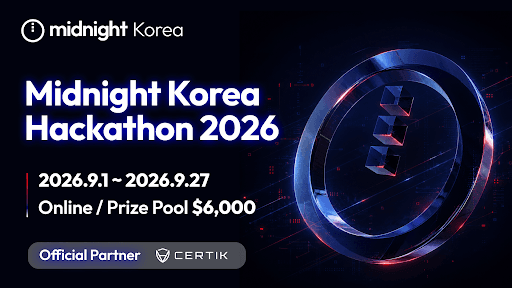
The hackathon generated applications focused on compliance, selective disclosure, and regulated finance. The winning projects deployed zero-knowledge proofs to solve specific institutional problems: JustEnough built a system for verifying public subsidy eligibility without exposing personal documents; Safejeonse developed a mechanism for renters to verify the safety of lease deposits without exposing other tenants' financial data; and Veilance designed a supply chain tracker to prove recycled material content for EU regulations without leaking supplier trade secrets.
Releases & Documentation
Mainnet node upgrade to 1.0.400
All mainnet validators upgraded to Midnight Node 1.0.400. This release applies a targeted security patch while keeping the core runtime environment unchanged. The source code and security advisory are available at the midnightntwrk/midnight-node repo. No action is required from developers, application users, and token holders.
Hosted indexer and RPC deprecation
The Midnight-hosted indexer and RPC endpoints for the mainnet and preprod networks permanently shut down on October 9. Application developers must now route data access through Blockfrost endpoints or operate independent indexers. Because synchronization states cannot transfer across different indexer services, applications saving local wallet data must discard previous files and sync directly from the genesis block. Find configuration examples on the networks and environments page, or consult the migration runbook for troubleshooting.
Updates occur regularly. Check the releases page and the compatibility matrix to stay up-to-date.
Join the community
Connect with developers, ecosystem partners, and the core engineering team on the official Midnight Discord.