
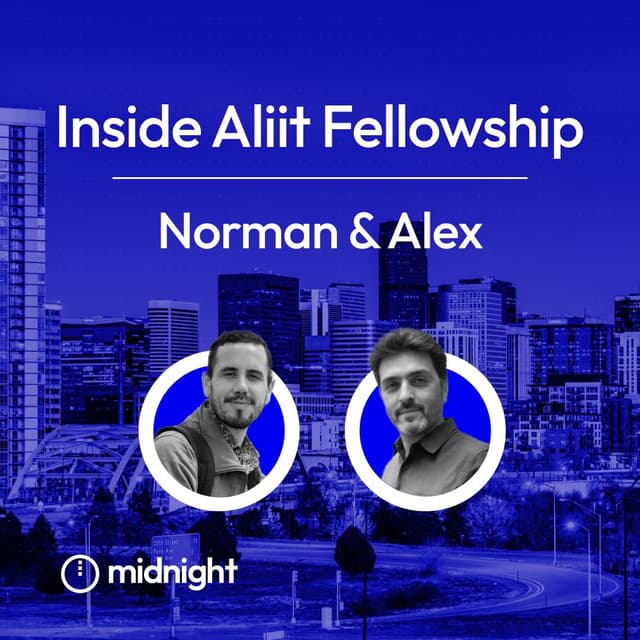
Developers weighing whether to apply to Aliit, Midnight's developer ambassador program, tend to hit the same wall. Plenty of curiosity, but the only information within reach is the program overview. So Midnight Korea went straight to two active Aliit members and asked what they actually do, what it took to get in, and what they got out of it.
We sat down with Alex and Norman, two Aliit Fellows, for a candid interview. Two developers from very different backgrounds, now in the same program. If you are on the fence about applying, their accounts are worth a read.
How two developers got here
Alex Pestchanker has been a developer for over forty years. He wrote his first program in 8-bit assembler in 1983, and has since worked in more languages than most developers ever touch: C, C++, Rust, Plutus, Aiken, and now Compact. He calls himself a true full-stack developer, and his track record backs it up.
Norman Lopez came from a very different path. He studied computer science at UT Austin and worked in QA and product at eBay and Nike. He came into crypto in 2022 through EVM and Solana, and now runs Kuira Labs, a mobile-focused privacy lab. He describes himself as a generalist mobile and web3 developer with a focus on UX.
One brought four decades of architecture experience. The other came in with no ZK experience at all, but with a conviction that mobile UX was the piece web3 had been missing. Different backgrounds, same program.
Why Midnight? For Alex, the pull was the abstraction layer and the promise of selective disclosure.
"Software shall not be the end goal. It is a tool to solve a human need, and complex tech like blockchain should be abstracted from the end user." — Alex
Norman started from the idea of connecting Bitcoin to DeFi, then found Midnight Network and saw a place where his mobile and UX ideas could finally take shape.
"Midnight looked like fresh terrain where I could actually put my ideas into practice." — Norman
You may be more ready than you think
Both of them, unprompted, named the same misconception: that Aliit is only open to developers who are already at the top.
Alex took it step by step. He completed the Midnight Academy courses, joined the NightForce ambassador program to get a feel for the community, and only then applied to Aliit. He spoke to no one before being accepted, and the whole process took about a month from application to acceptance.
Norman applied after two Midnight hackathons and an email inviting him to Aliit cohort 0. He was upfront about his intentions: build DApps for mobile, and bring Midnight to communities in Mexico and Latin America. He wasn't sure he was ready, but he went for it anyway.
There was no secret threshold they had to meet. The requirement was simple: show that you are a real developer who wants to learn ZK and build something on Midnight Network. As Alex learned, the program welcomes any developer with the will to learn.
"They think it is only for developers that are already in the TOP." — Alex
What an Aliit Fellow actually does
There are two stages. You start as a Builder, and some go on to become Fellows.
As a Builder, you work through Zealy quests to reach 1,500 points and qualify for Fellow review. The quests cover a wide range, so you pick what fits you: education, documentation, bug fixes across the Midnight toolset, technical writing. Coding is a given. To qualify, you need to finish at least one meaningful coding task.
Once you're a Fellow, the fixed structure falls away. Alex, now a Fellow, works entirely self-directed and files a monthly report on his technical contributions. Norman estimates that about 99% of his work is self-directed. You decide what matters to the ecosystem and plan your own contributions. Writing code for Midnight remains mandatory. There is no minimum number of hours or lines, but moving up means showing growing impact month over month.
Alex’s project: Agentic Multipass
The output is real. Alex has reported bugs and contributed improvements across the Midnight docs, SDK, and Midnight Expert, and his own Midnight Problem Statement was accepted as MPS-0029. His main project, Agentic Multipass, builds selective-disclosure security for autonomous agents. He also runs the bi-weekly Aliit Builder's Hangout.
Norman built two things. One is the Midnight Wallet CLI, a command-line wallet with over 3,000 npm downloads. The other is the Kuira SDK for Android, which generates proofs on-device with no Proof Server and no seed phrase. Both shipped during the program.
There is no fixed weekly time commitment. Norman runs several projects at once and puts in more than 20 hours a week, but says around 5 is enough if you focus on a single project. Alex points to the one thing he wishes he'd known: you only really understand the time commitment once you're in.
What Aliit gives you beyond building alone
Norman Introduces his demo on Fireside Dev Hang, Midnight Foundation's weekly developer stream
For Alex, much of Aliit's value comes from proximity to the ecosystem: first-hand information on the features being built, the thinking behind them, and the people building them. Since becoming a member, his presence in the ecosystem has grown, opening doors to initiatives and projects. "The best is yet to come," he says, because both the program and the blockchain are still young.
For Norman, his involvement eventually led to a job. His work led to a Technical Moderator offer on the Midnight DevRel team. He earned a slot to demo his projects on Fireside Dev Hang, Midnight Foundation's weekly developer stream, and an invitation to speak at Consensus Miami 2026. The CLI wallet and SDK, the downloads, the job offer, the conference: all of it happened during the program.
What surprised Norman most was the answer to a question he almost didn't ask. What happens to your own projects once you join?
"Your projects don't stay side projects. Watching someone else ship on top of your tools is a different kind of reward." — Norman
Recently a member built a payment Vault DApp on top of Norman's Android SDK in about ten minutes and posted it on X. Midnight DevRel team promoted both of his releases and gave him a spot on Fireside Dev Hang. His projects did not stay side projects.
What to know before you apply
Both were clear about who should not apply.
If you're after an immediate financial reward, this program isn't for you. If you want to build quietly on your own, it probably isn't either. The ambassador role is not a side detail. Helping others learn, use, and succeed on Midnight Network is the core of what an Aliit Fellow does.
"If you are just a developer that wants to build on your own, probably the Aliit is not for you." — Alex
What mattered to Aliit was not prior ZK knowledge. Norman came in with none. What counted was the ability to learn and adapt quickly, research your way through blockers, manage your own time, and keep going when things break. Both said experience from other ecosystems helped. Alex's Cardano background let him grasp Midnight's UTXO model quickly, and Norman's EVM and Solana work gave him a basis for comparison.
For both, the steepest climb was conceptual. For Alex it was the mathematics of ZK, then the Midnight architecture: Indexer, Proof Server, wallets, shielded and unshielded tokens. Norman points to the shift in mental model, moving from web2 into web3 and ZK, including learning how UTXOs work. When stuck, they turned to Midnight Expert and the docs first, then the Aliit channels, fellows, and Midnight Foundation's technical staff.
On one point, both were fully aligned: the support they received from the Midnight team. Alex put it this way:
"They are receptive and responsive, and they walk the talk." — Alex
How to start now
If you're interested in Aliit but still hesitating, both suggest a simple way to start without making a big commitment.
Midnight Awesome DApps repo
Start by going to dev-chat in the Midnight Discord and reading the problems other developers post. If you find yourself wanting to solve one of them, that's a good sign. Then browse the Awesome DApps repo. If you find yourself thinking, I want to build something like this, you probably already have your answer.
If you feel you're not ready, Alex points to the Midnight Academy courses.
Midnight Academy
Norman puts it differently: you're never really ready. Pick a problem you want to solve in the privacy space, write down what you'd need to solve it, and that list becomes your roadmap. Once you start working on the problem, the question of whether you're ready enough fades on its own.
Norman applied with a personal goal no one assigned him: bringing Midnight to developers in Mexico and Latin America (LATAM), in their own language and context. Alex believes local communities are the key to worldwide adoption. Read their words side by side and the same message surfaces. The ecosystem is early enough that whoever builds the tools, content, and community for their region gets noticed right away.
For every developer interested in Midnight, that seat is open right now. It could be you.
Apply now: https://midnight.network/aliit