
Deep DUST Dive
The recent series of blogs explaining DUST across varying levels of complexity has been designed to give developers and community members a clear view into one of Midnight’s standout protocol features. These guides help to explain how DUST works, and demonstrate how it overcomes longstanding issues for blockchain accessibility and user experience.
Anyone looking to get started learning the basics of DUST can begin with An introduction to DUST on Midnight, which outlines how DUST acts as a private, non-transferable resource to execute smart contracts.
Building on those fundamentals, The mechanics of DUST generation and decay published earlier this month breaks down the network's token-generates-resource model. The generation and depletion of the DUST resource moves through a distinct four-phase cycle: generation, constant-capacity, decay, and empty. This structure maintains predictable network resource caps while letting inactive allocations fade linearly without bloating ledger state.
Holding NIGHT allows users to register an address to generate DUST at a constant linear rate, where 1 NIGHT yields up to 5 DUST. Token holders maintain total control over this association, updating or revoking registration at any time.
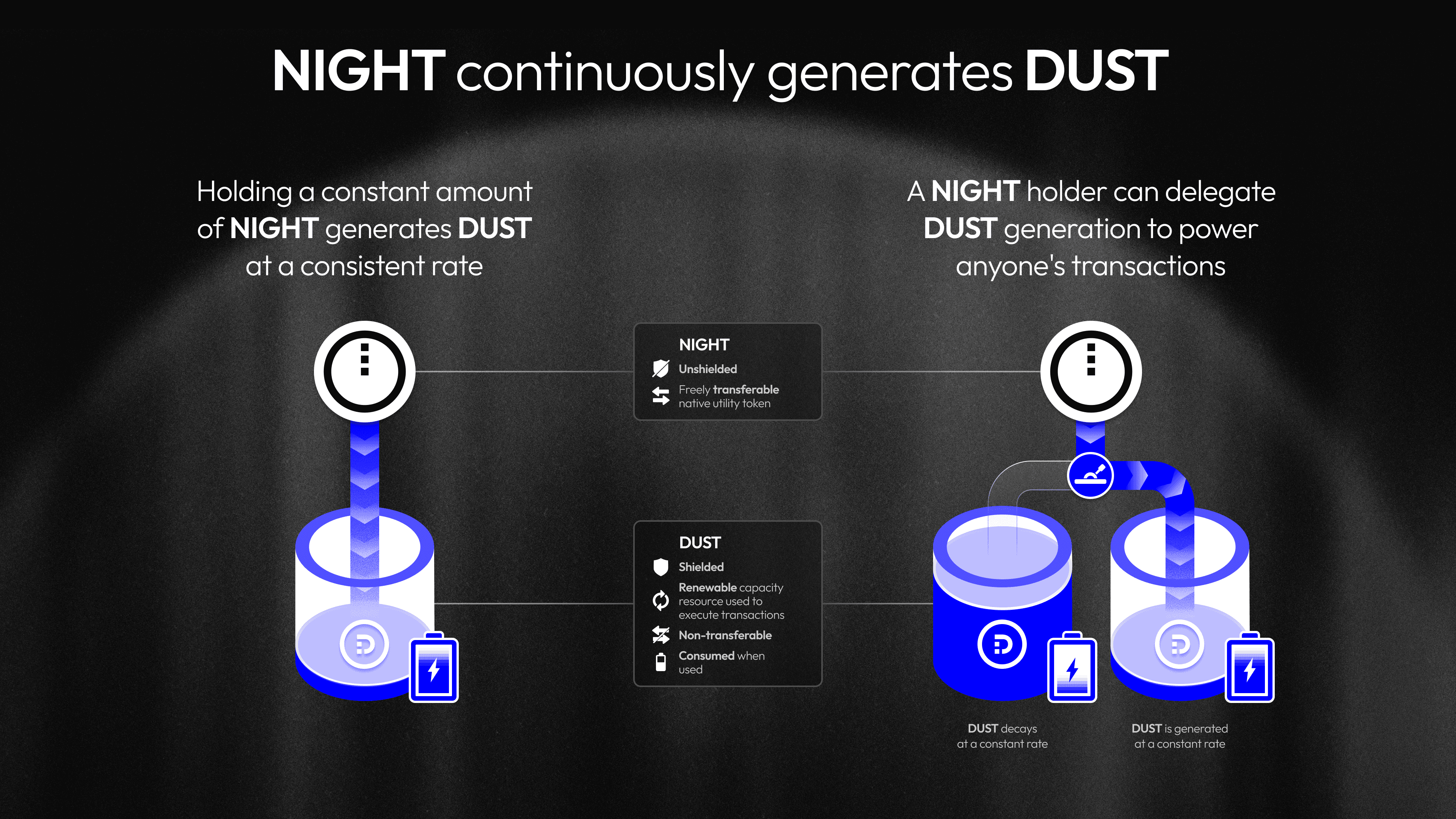
Separating the capital asset (NIGHT) from the resource (DUST) opens up advanced applications, including DUST sponsorship. Most decentralized applications lose up to 80% of users during onboarding due to the friction of acquiring native tokens for gas fees. Fee sponsorship resolves this drop-off by enabling developers or third parties to cover DUST costs on behalf of end users. The NIGHT-generates-DUST model is more sustainable because transactions can be powered without ever expending the capital asset (NIGHT). This can deliver a user experience on par with Web2-style apps without compromising on privacy.
For a non-technical breakdown of how DUST sponsorship works, with a detailed infographic, check out the latest blog. And for a more detailed technical walkthrough of DUST sponsorship, Midnight Foundation Developer Educator Idris Olubisi explains the full process.
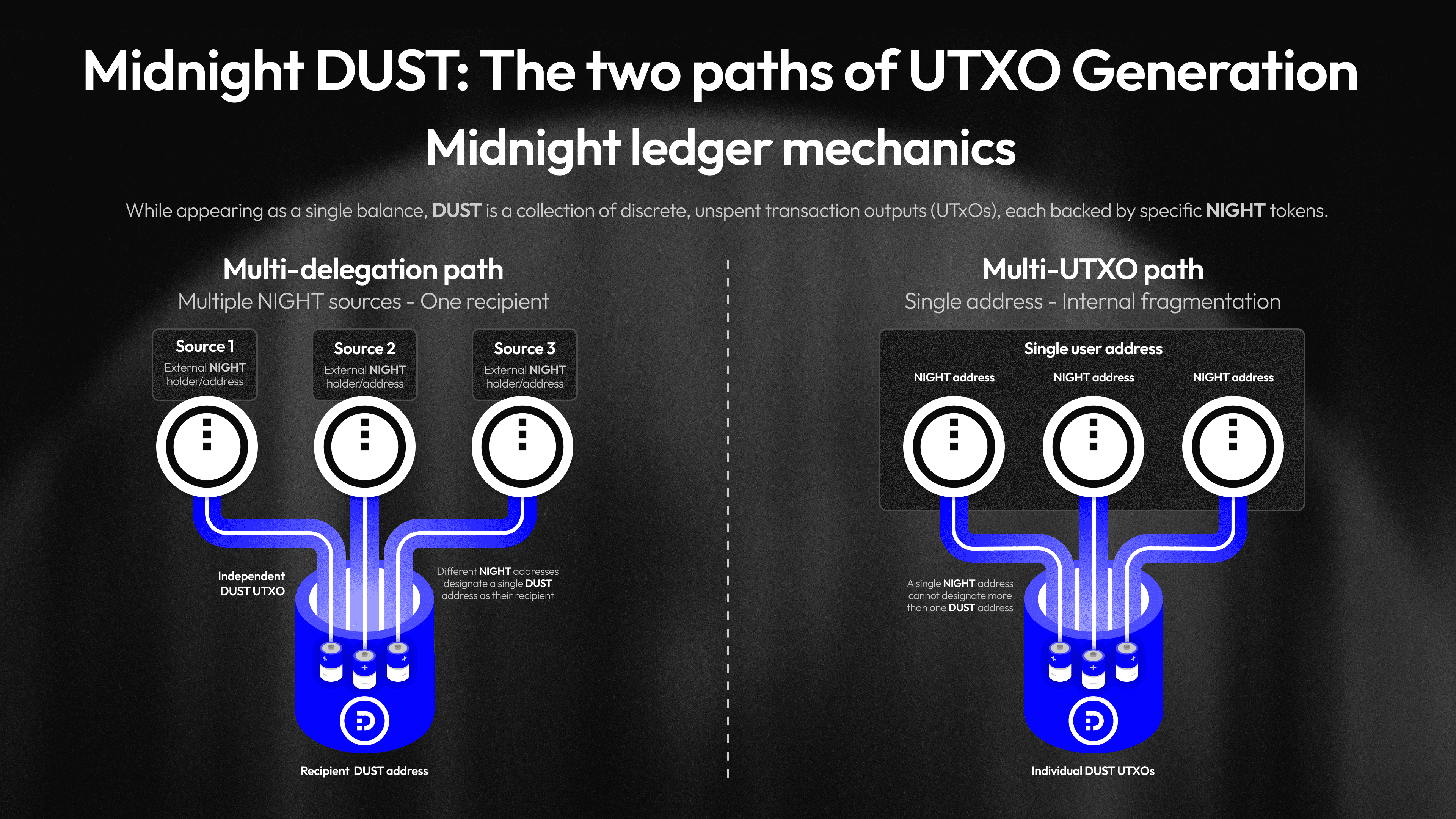
For an even deeper look into Midnight’s ledger mechanics, Understanding the multiple pathways to generating DUST details how multiple NIGHT addresses can generate DUST to a single address. It also explains how a single NIGHT address can contain multiple UTXOs which are designated to a single DUST address.
And there are now two Midnight wallets that make the NIGHT designation and DUST generation extraordinarily easy, all within the wallet app. Check out 1AM Wallet and Gero Wallet.
Ecosystem Partners
Infrastructure providers, exchanges, and wallet developers continue to expand the network's tooling, liquidity, and regional accessibility. Recent updates bring cross-chain messaging, decentralized storage, Japanese exchange access, and enhanced wallet client software to the Midnight universe.
VIA Labs
VIA Labs launched its universal cross-chain messaging protocol live on the Midnight network, establishing direct contract-to-contract communication across external blockchains. The bridge operates without synthetic or wrapped assets; instead, smart contracts mint, burn, or transfer cryptographic messages directly between Midnight and destination chains like Cardano and EVM networks.
This live deployment brings cross-chain interoperability to zero-knowledge applications. Developers can execute multi-chain contract logic, allowing external applications to verify Midnight’s private state proofs without exposing underlying user data. By connecting Midnight to over 130 public and private networks, the integration expands liquidity access, enables cross-chain asset transfers, and opens up cross-ledger decentralized applications across the ecosystem. Learn more.
Celestia
Private markets face a key hurdle: making trade offers discoverable across applications without exposing user identities or wallet balances. Midnight addresses this challenge by pairing Zswap atomic swaps with Celestia's data layer for offer discovery. Developers post trade offers to a shared Celestia namespace where external wallets index and match orders in real time. Zswap maintains strict privacy for transacting parties, allowing applications to access ecosystem-wide liquidity without building custom message-sharing networks. Read more in the the recent Celestia blog.
Lumera
Lumera brings Cascade, its decentralized storage layer, to the Midnight network. Cascade provides permanent, off-chain storage for encrypted files, credential references, zero-knowledge proof anchors, and real-world asset data. This integration allows developers to store large, encrypted datasets externally without sacrificing data availability. The Midnight protocol processes access control and ownership logic, keeping the on-chain state lean while supporting data-heavy decentralized applications. Learn more.
S.BLOX
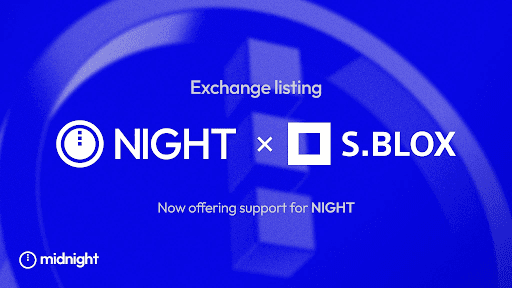
In Japan, NIGHT is now available on S.BLOX, a Sony group company. This listing expands direct access to NIGHT within one of the world's most established digital asset markets. The addition strengthens the network's presence in Japan while driving broader adoption across the region and supporting the growing community involvement.
Ascend
Ascend launched a verifiable events perpetuals exchange and orderbook spot DEX on Midnight, introducing perpetual futures to the protocol for the first time. The platform settles trades through zero-knowledge proofs across Cardano, EVM chains, and Solana. Users can execute long or short margin positions on real-world outcomes while maintaining privacy across connected blockchains. Check out the DApp here.
Sundae Labs Capacity Exchange
The Sundae Labs Capacity Exchange now enables users to settle transaction fees on supported Midnight applications using USDM instead of DUST. The exchange converts alternative token payments into the network's required execution resource behind the scenes. Learn more in the latest announcement.
CertiK
CertiK partners with the Midnight Foundation to provide smart contract auditing and real-time security monitoring across network protocols and decentralized applications. CertiK checks contract code, zero-knowledge circuits, and system infrastructure for vulnerabilities before deployment.
Gero Wallet
Gero Wallet releases version 2.7.0, which introduces multi-account support, expanded token functionality, and user interface improvements. The client software now processes transaction creation, display, and management through a reorganized interface, alongside broadened support for digital assets and backend stability fixes. These refinements give power users direct control over multiple accounts, reducing operational friction for individuals managing complex asset portfolios across networks.
Learn more by browsing the Midnight ecosystem catalog.
Builder Events
Midnight builder momentum continues in Japan with the Midnight Buildathon on AKINDO. This comes with $12,500 in grant funding across three waves in three months. Start a project during the first wave, and continue to improve on your project through each wave as you learn more, refine your ideas, and build on your concepts. This process provides builders with milestone funding, direct technical feedback, and the runway needed to take privacy-focused applications from initial proof-of-concept to production. Learn more and register here.
Check out the hackathons page to keep an eye on all the upcoming challenges and hacks.
Releases & Documentation
Midnight Node 2.1.0 enables live-chain upgrades
Midnight Node version 2.1.0-beta.1 has been released to Preprod and Mainnet. It incorporates the full feature set of the 2.0.0 release line alongside recent maintenance and security patches. This is a binary and runtime upgrade: spec_version moves 1_000_003 → 2_001_000 and transaction_version moves 3 → 4. Enacting it is a ledger 8 → 9 hard fork with an on-chain multi-block migration.
This release introduces direct hard-fork capabilities from active 1.0.3 chains. Read the full release notes here.
Updates occur regularly. Check the releases page and the compatibility matrix to stay up-to-date.
Join the community
To talk with the community about everything Midnight, join the community on Discord.