


If you’ve been exploring the architecture of the Midnight network, you likely know that it uses a unique dual-component tokenomics model. In the Midnight ecosystem, the NIGHT token acts as a store of value; generates DUST (a shielded, non-transferable, consumable resource used exclusively to pay for transaction fees) when registered; and will be used as a governance mechanism.
To understand how DUST accumulates, it is important to know that Midnight's core ledger operates on a hybrid ledger model with contracts using an account-based model, and shielded and unshielded tokens and DUST uses an Unspent Transaction Output (UTXO) model. This means that ledger-based tokens and DUST balances are not stored as a single balance, but rather as a collection of unspent outputs. Learn more about the UTXO model here.
DUST, like NIGHT tokens, is represented as a collection of UTXOs, each with its own independent lifecycle. At any given block, the effective amount of DUST available to a user is the sum of the current value of all their unspent DUST UTXOs that are held within the same address, regardless of whether those individual UTXOs are currently generating, decaying, or sitting at full capacity.
Transaction throughput and the UTXO model
Each network transaction requires at least one DUST UTxO. Holding a single DUST UTXO limits transaction throughput because the user must wait for the system to generate the resulting change UTXO before spending again.
A good analogy to explain this mechanic is spending a bank note. A single twenty-dollar bill can only be spent once. You cannot give the same twenty-dollar bill to pay for two different transactions, you would need to receive change for the first transaction before initiating another.
However, holding two ten-dollar bills would allow you to pay for two transactions at the same time, allowing you to spend each independently and simultaneously, avoiding the delay for change.
This directly impacts transaction sponsorship and capacity exchange, as throughput scales with the number of available DUST UTXOs. An address with one DUST UTXO can sponsor one transaction per unit time, whereas an address with two UTXOs doubles that capacity, assuming the total DUST volume is sufficient to cover the fees.
Visualizing accumulation paths
The infographic below illustrates how a single DUST address can accumulate these concurrent streams of the DUST resource from either the multi-designation path (multiple NIGHT addresses to a single DUST address) and the multi-UTXO path (a single address containing multiple NIGHT UTXOs to a single DUST address).
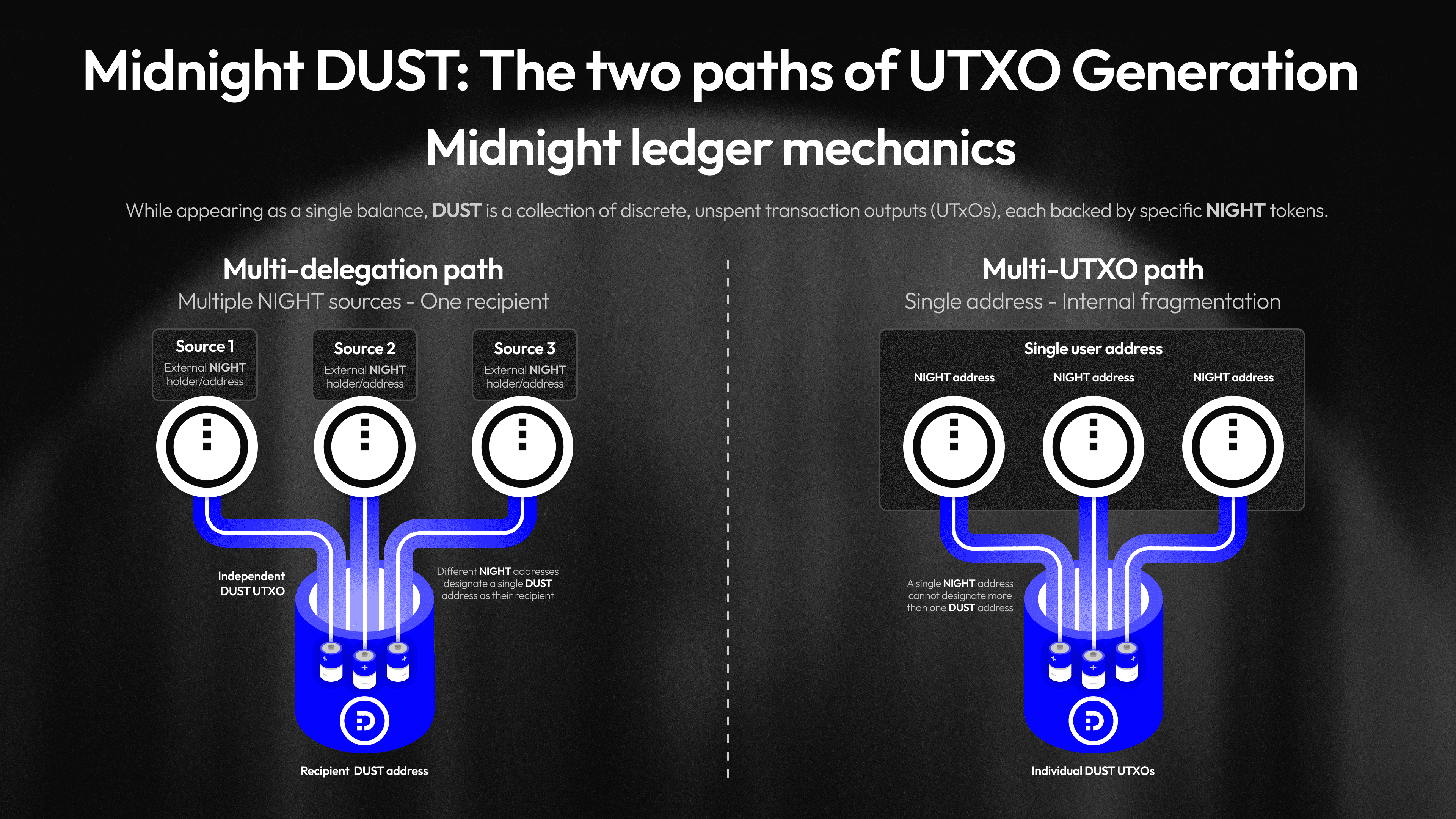
Path 1: The Multi-Designation Path
The first path illustrated in the infographic demonstrates how multiple different NIGHT addresses can explicitly designate the same recipient DUST address.
On Midnight, passively holding NIGHT does not automatically yield DUST; a NIGHT holder must explicitly register an association to initiate DUST generation. Because this system is flexible, a NIGHT holder can designate any DUST address as their destination, including addresses not controlled by them.
If additional NIGHT addresses designate their generation to the same DUST address, the aggregate for that recipient increases. As a result, the maximum DUST cap for that receiving address increases proportionally, and new, separate DUST UTXOs are generated.
Path 2: The Multi-UTXO Path
The second path explores what happens when a single NIGHT address contains multiple NIGHT UTXOs. Even if a user is generating DUST purely from their own NIGHT tokens to their own DUST address, they can still accumulate multiple separate DUST UTxOs simultaneously.
When a user registers a NIGHT address for DUST generation, the ledger records this designation at the address level using its public key (hence, a NIGHT address can only be delegated to a single DUST address). However, in practice, the Midnight ledger applies this designation to each eligible NIGHT UTXO individually, meaning that DUST generation is strictly tracked on a per-UTXO basis.
Consequently, if a single NIGHT address holds several distinct NIGHT UTXOs, each one of those inputs acts as its own "power plant," producing and charging its own corresponding DUST UTXO with its own specific creation time, nonce, and lifecycle.
Making best use of UTXO pathways
Whether through multiple users or NIGHT addresses pointing their DUST generation toward a shared application (multi-designation) or a single user holding various unspent outputs (multi-UTXO), Midnight’s UTXO-based architecture ensures that DUST generation is flexible down to the individual token output.
This specific mechanism is incredibly powerful for Web3 adoption, as it allows entities to sponsor transaction fees for decentralized applications, granting end-users access to the network without requiring them to own NIGHT tokens or understand the underlying blockchain mechanics. By understanding these pathways, developers and users can better strategize how to manage network capacity and utilize DUST to power private, predictable transactions.