
What happens when you give builders two weeks, privacy-enhancing technology, and real-world problems to solve?
The result is the Hilo Hackathon, an invite-only event for attendees of the Midnight Summit. Teams had two weeks to design and code DApps, with ideas spanning healthcare, finance, AI, and identity.
Hackers were shortlisted based on a code review to identify the top two teams for each track. The hackers presented four-minute demos on May 1 and the winners were announced live at Consensus Miami 2026.
Congratulations to all of the winners. Together, they demonstrated Midnight’s functionality, and provided a glimpse into where the network is heading.
Learn more about the winning Hilo hacks to see what impresses the judges and how to build a winning Midnight project.
Overall grand prize + healthcare track winner - Tartufo
The Tartufo team took home the grand prize, and top spot in the healthcare track with their VaxZK dApp. VaxZK lets users prove their vaccination status without revealing their personal medical data.
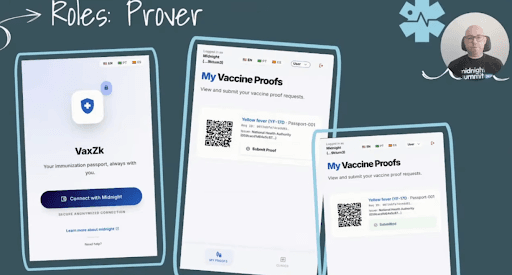
It uses Midnight’s zero-knowledge architecture and selective disclosure information. An authorized issuer, such as a health clinic or recognized authority, provides a signed certificate that the user keeps encrypted and private. When evidence is required, the verifier (border control, airline, venue, etc.) creates a proof request on-chain and presents a QR code. The user scans the code, generates a ZK proof which confirms their vaccination status on-chain, without revealing any of their personal data.
The scale of this use case is vast. With VaxZK, airports, workplaces, and venues can all verify compliance without holding sensitive information. Crucially, this also enables businesses to verify information without having to be data custodians; they can avoid the administrative burden of data management, and the costs and risks associated with processing and storing personal data.
The judges were impressed to see a working example of a use case using ZK technology that is so often discussed conceptually. Great hackathon projects are often straightforward implementations that bring Midnight’s privacy-enhancing technology to existing applications and products.
Check out Tartufo’s winning presentation, and a brilliant example of how to showcase a product, on the Midnight YouTube channel and check out their code on GitHub.
Finance track winner - Fairway
The Fairway team took top honors in the finance track with KAAMOS, an OTC settlement layer built for Midnight and Cardano.
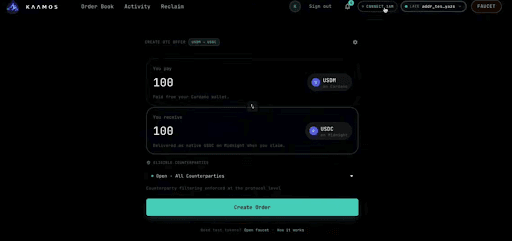
Imagine a bank needs to move $5 million between two chains. Public transactions expose positions, while bridges introduce additional risk. KAAMOS solves both.
The project shows how Midnight expands beyond standard atomic swaps. Hidden counterparties keep participants private while shielded transactions hide positions. Through selective disclosure, users reveal only the information required. The result is a private, secure alternative for cross-chain value transfer on an institutional scale.
The judges were impressed by the development progress made, given the short hackathon timeline. They highlighted how KAAMOS tackles a problem at the heart of the global financial system and were excited by the scale of this use case across markets. You can watch their presentation and product demo here and find their code on GitHub.
AI track winner - Oblivion Protocol
The Oblivion Protocol team earned first place in the AI category with their ZK.LY.
ZK.LY addresses a common issue in marketing campaigns: fake engagement. Platforms like Zealy rely heavily on trust, assuming users complete quests honestly. Yet screenshots are regularly faked, and accounts are sold to game the system.
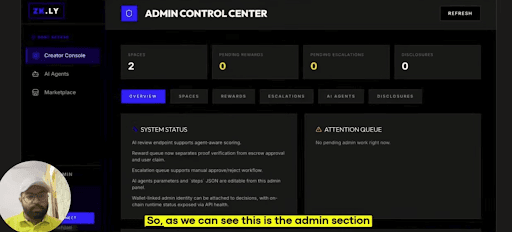
ZK.LY solves this with trustless verification. Users complete tasks across social platforms, campaigns, and on-chain activities, while AI reviews submissions against predefined criteria. Then Midnight’s infrastructure takes over. A ZK proof is created that confirms the task met the required standard. In effect, this is Zealy with verification built in.
The judges commented that the contract was neatly organized and made good use of modules. They encouraged the team to provide more guidance on how to navigate the UI and to sharpen the value proposition for why users would move from competitor platforms. Check out their full presentation to see ZK.LY in action and find their code on GitHub.
Identity track winner - Black8
The Black8 team took first place in the identity track with AnchorZK, a DApp focused on verifying that photos are real, and their provenance confirmed by the sensors of the device.
As AI-generated content becomes harder to distinguish from authentic media, verification is an even more important challenge to solve. Existing standards like C2PA help prove provenance, but they also expose sensitive metadata, including identity, location, and timestamps.
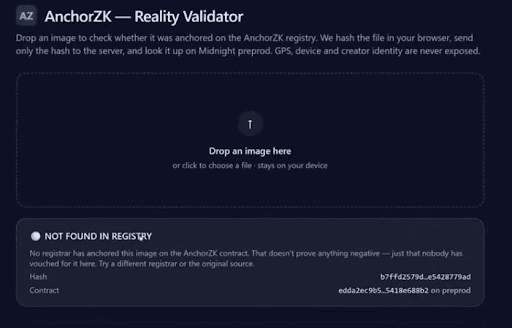
AnchorZK extends the existing C2PA media verification standard. First, a trusted registrar verifies the asset history off-chain. The AnchorZK application then logs a secure four-part dataset on Midnight that contains the content fingerprint, region, month, and the registrar's cryptographic verification.
This enables verification of image authenticity while sensitive data never leaves the local device. In practice, that means a publisher can validate media from a whistleblower without exposing the underlying details on-chain, eliminating the privacy and security risks associated with data leaks.
The judges highlighted AI verification as a significant long-term opportunity for Midnight’s privacy-enhancing technology, with a market far beyond blockchain ecosystems. Watch the full presentation on the Midnight YouTube channel and find their code on GitHub.
What’s Next?
Keep building, and keep an eye on the Midnight hackathons page for what’s coming next.