Total visibility makes blockchain exceptionally useful when you want transparency.
However, public blockchains make privacy impossible by design. Open ledgers work well when tracking public token transfers, but default visibility becomes a dealbreaker for real-world business. Few organizations choose to record medical records, corporate balance sheets, financial payments, or personal IDs on a public network where every competitor and stranger can see them.
Data privacy risks on public blockchains
The tension between public ledgers and data protection is an ongoing challenge for blockchain adoption.
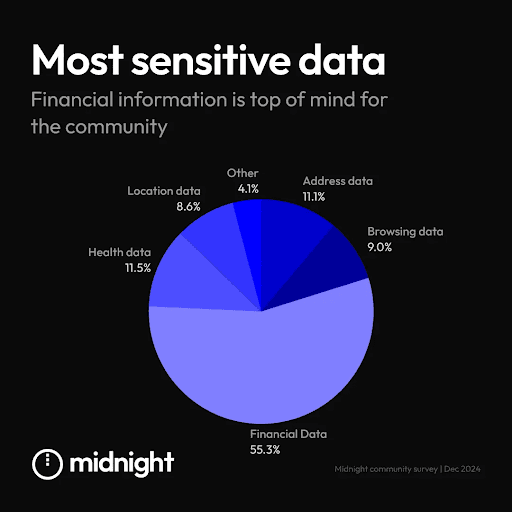
In a global survey conducted by the Midnight Foundation, 56% of respondents prioritized protecting financial data above every other category. People and organizations want to use decentralized networks, but they cannot afford to broadcast their balances, payments, or treasury data to the world.
Yet most blockchain applications, by their design, rely on an open ledger with transparent, immutable data. And immutable public data is a major risk in its own right.
A healthcare application shouldn’t expose someone’s medical status because it uses blockchain infrastructure – and within most regulatory frameworks, it cannot. A financial institution shouldn't make every transaction public and expect clients to accept that risk. An identity system should not require someone to reveal all their personal information just to prove one specific fact.
Transparency is valuable for public accountability and auditing, but real-world use cases need control over what becomes visible and to whom.
Verifying without exposure using zero-knowledge proofs
Zero-knowledge proofs help solve part of that problem. A zero-knowledge proof allows someone to prove that something is true without exposing all of the underlying data.
A simple example is age verification. A person may need to prove they are over 18 without showing their full ID, name, date of birth, or address. The verifier only needs to know whether the requirement has been met. The rest of the information can, and should, stay private.
That same idea can be applied more broadly. If any system can verify that an output is correct or that a user is eligible, the system works without the additional data exposure – and without that additional layer of risk.
This protects user privacy, and reduces the risks for businesses and developers associated with processing and storing sensitive data.
Balancing privacy and transparency with selective disclosure
Midnight’s selective disclosure capabilities make this possible.
Instead of making everything public or keeping everything hidden, selective disclosure allows specific information to be shared, under certain conditions based on pre-programmed rules. This creates a more useful balance between privacy and transparency. One that’s less about stark principles, and more about how the tech actually works in real, day-to-day life.
For users, this means less data is unnecessarily exposed. For builders, it opens up new windows for DApps and design. And, crucially, for businesses and institutions, it removes a major barrier and friction for wider adoption.
Protecting sensitive data with Midnight
Midnight is built to apply privacy-enhancing technology to real-world applications.
The network empowers builders to decide what should remain private and what should be disclosed. Applications can still benefit from blockchain’s security and auditability, while protecting sensitive user data, and adapting to the realities of modern business.
Mainstream adoption of decentralized technologies requires more than transparency. It needs confidentiality and compliance. It needs the trust of a transparent, secure network and the trust that comes with data protection.
Midnight provides programmable privacy by design.
Connect with the Midnight community on Discord.