
International research aligns with the results of the second annual Midnight community survey, confirming that data protection is a universal demand rather than a regional preference.
Privacy concerns are consistent worldwide, though specific technical and social drivers vary by market. Findings from Pew Research, Cisco, KnowBe4 and OAIC identify regional themes.
- Autonomy and tracking: In the United States, 81% of adults are concerned about how companies use the data they collect, and 62% report that avoiding daily tracking is impossible.
- Human-centric design: European data indicates 81% of people say that improved data collection is essential, with 89% prioritizing technology designed to protect user rights by default.
- Trust and integrity: 95% of people in Japan report that improved privacy standards had a positive impact on their business (along with 94% in China and India)
- Security and theft: In South Africa, Kenya, and Nigeria, 58% of citizens report being highly concerned about data theft following a 40% increase in breaches in the region.
- Control and risk: In Australia, 84% of people want greater control over personal information, identifying data breaches as their primary privacy risk.
These regional priorities reflect a shared global experience. Whether driven by the fear of tracking or the demand for digital autonomy, the requirement for robust and programmable privacy is a worldwide demand.
The privacy paradox
The Aleo 2025 Privacy Gap Report reveals a disconnect between Web3 capital and the tools available to protect it. While institutional stablecoin volume reached $1.22 trillion recently, only 0.0013% settled on private rails. This transparency turns transfers into "market-moving intel" for competitors; for example, market makers like Wintermute average 73,000 daily transactions visible to the public.
This technical gap creates a privacy paradox driven by a lack of agency and accessibility rather than a lack of interest. Only 10% of users report high trust in cryptocurrency companies, yet 67% said they would switch to products offering Zero-Knowledge proofs.
Midnight addresses this through rational privacy, moving beyond the false binary of total transparency versus total secrecy. By providing the tools to make data protection accessible and programmable, Midnight enables developers and users to develop applications which disclose only what is necessary, transforming privacy from a manual burden into a programmable standard.
Privacy is universal
The first article in this series of results from Midnight’s second annual community survey chartered the Midnight community’s substantial global expansion. Data from the second annual community survey identifies the shared values and technical requirements that drive participation across different regions.
The latest Midnight community survey reveals a rare consensus that aligns with broader global research: privacy is not a niche interest, but a core demand for internet users of every experience level.
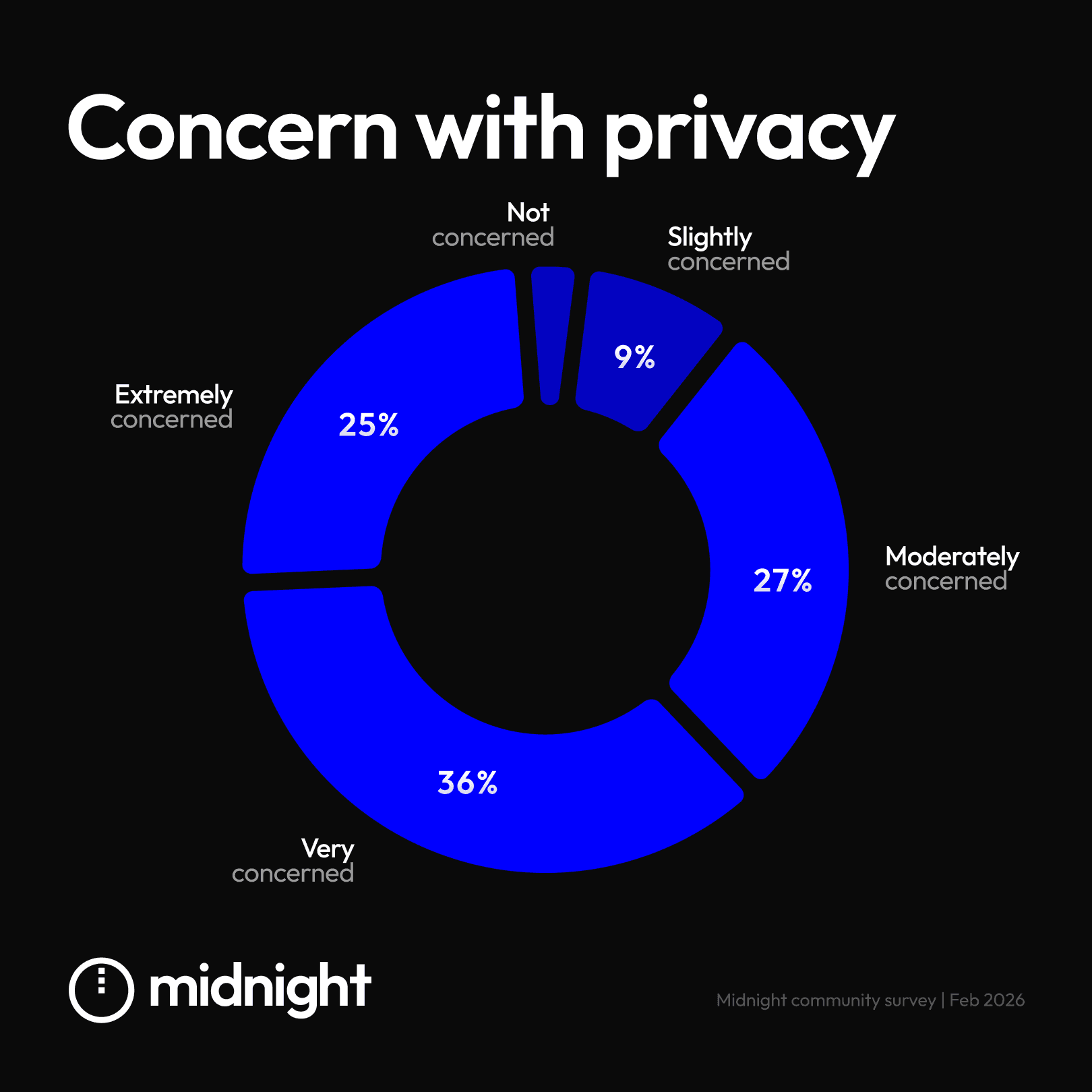
The data from Midnight’s community research shows that nearly 90% of respondents are concerned with the privacy of their data. Only 3.3% reported being "Not Concerned" about their personal privacy, while only 8.8% were only "Slightly Concerned."
This is reinforced by active user behavior: in the first Midnight community survey, 92% of respondents reported taking steps to limit the data an app can access, and 94% had deleted an app specifically due to data protection concerns.
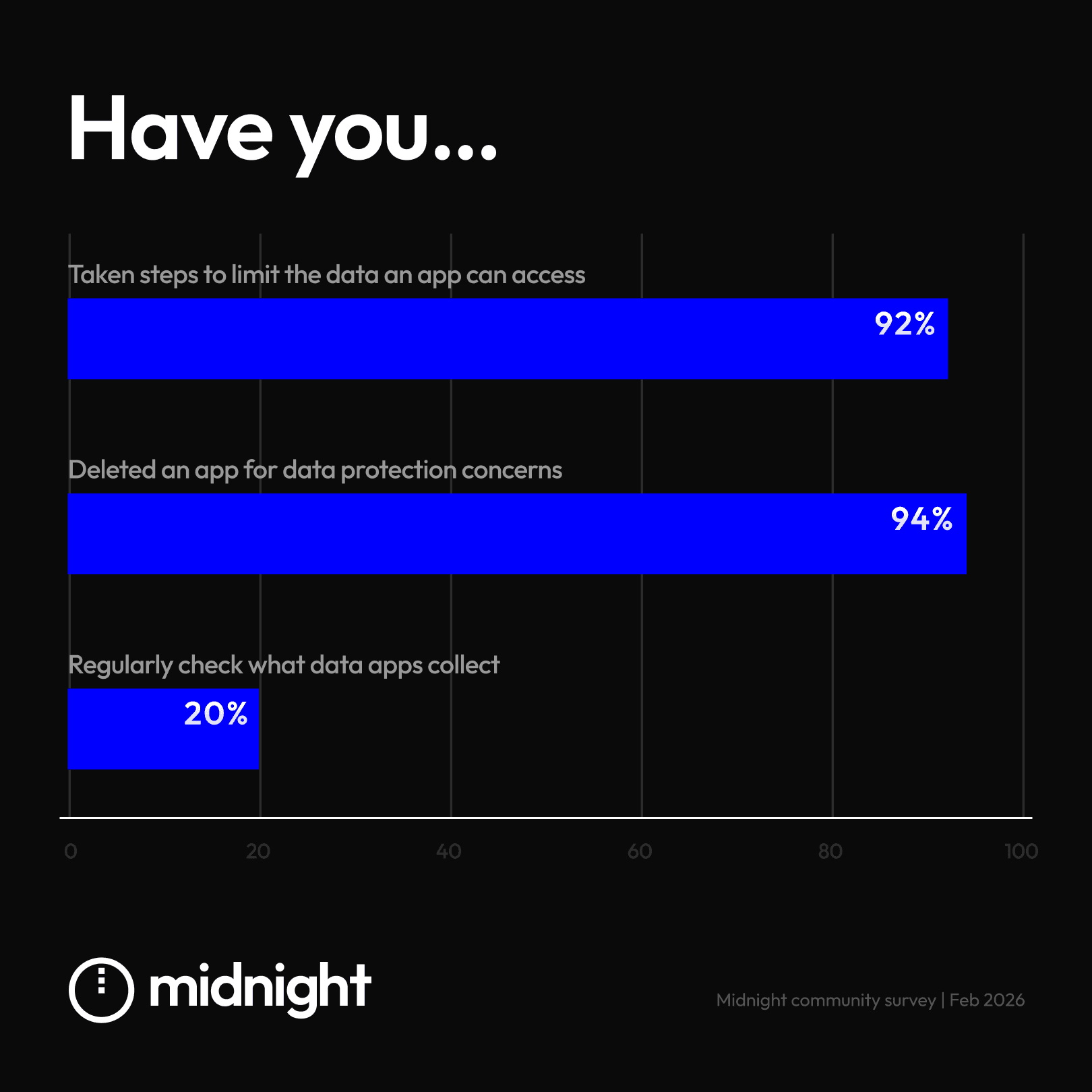
Although people do act on their privacy concerns, and while most survey respondents reported taking specific actions at least once, they did not report taking universal action to customize all privacy settings across their entire digital lives.
This reveals a crucial insight: users are deeply concerned and willing to act, but they are overwhelmed by the minutiae of individual app settings and convoluted privacy policies. They do not lack the desire for privacy; they lack the tools that make effectively managing it realistic.
Privacy as the cross-chain unifier
Blockchain communities often fragment into "tribes" over consensus mechanisms or programming languages. Yet, when asked about privacy and data protection, responses are remarkably consistent. Analysis shows no statistically significant difference in privacy concern among users across 8 ecosystems.
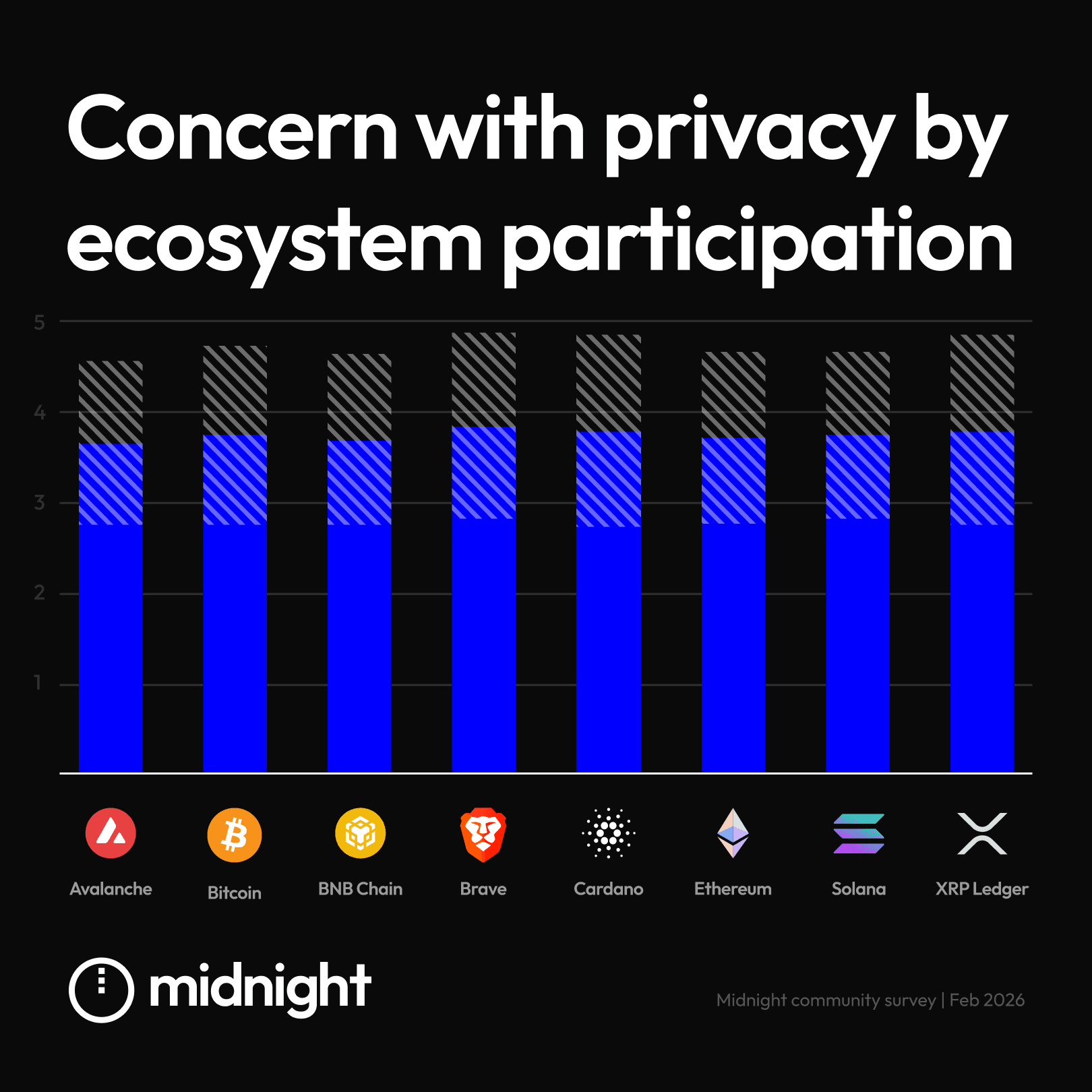
This consensus across communities suggests that while users select networks for various reasons and preferences, privacy is equally important to all.
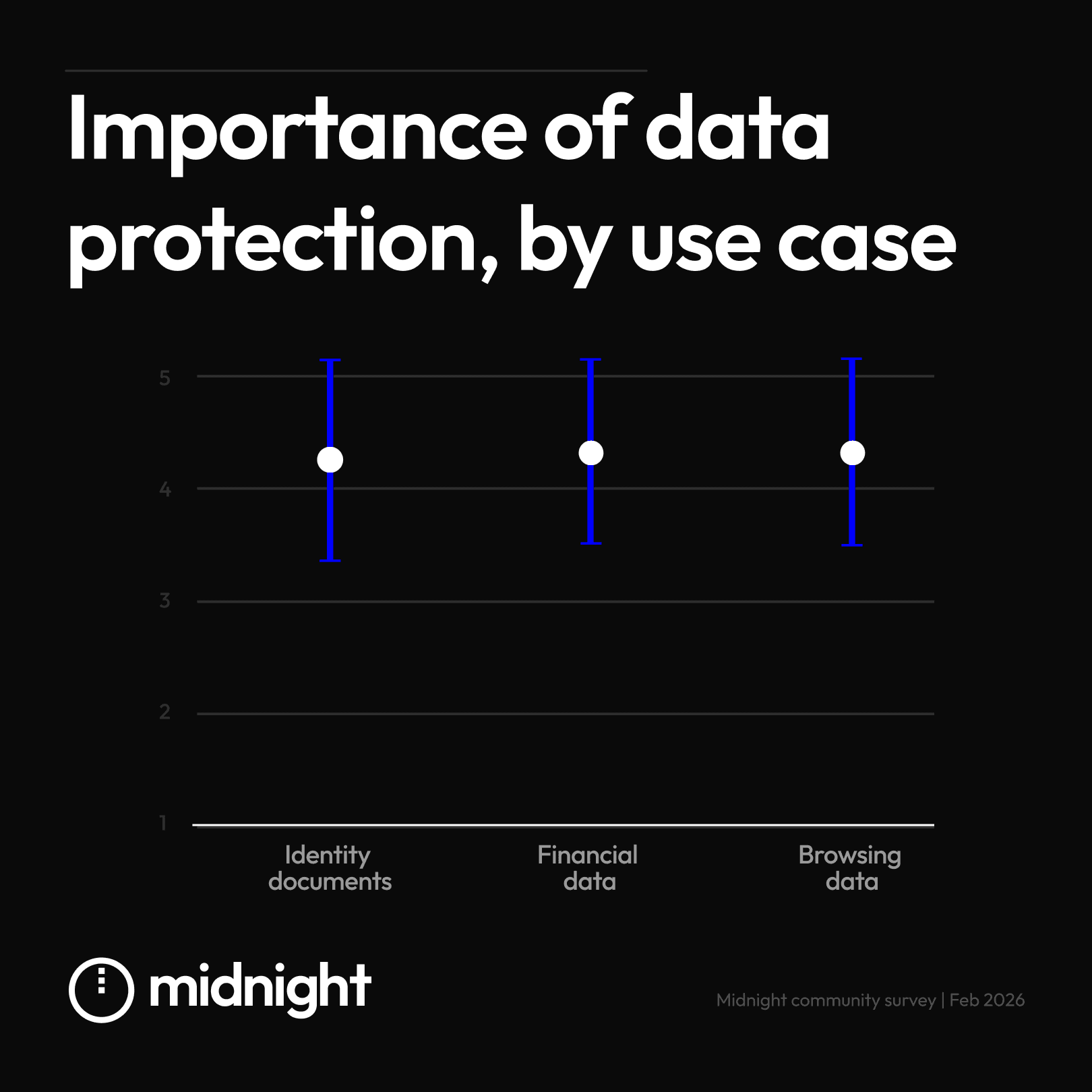
Respondents rated the protection of identity, financial, and browsing data as similarly important, echoing findings from the previous Midnight survey. Yet, a forced-choice analysis reveals a specific hierarchy: 56% of the community prioritizes financial data above all other categories.
Experts and beginners agree
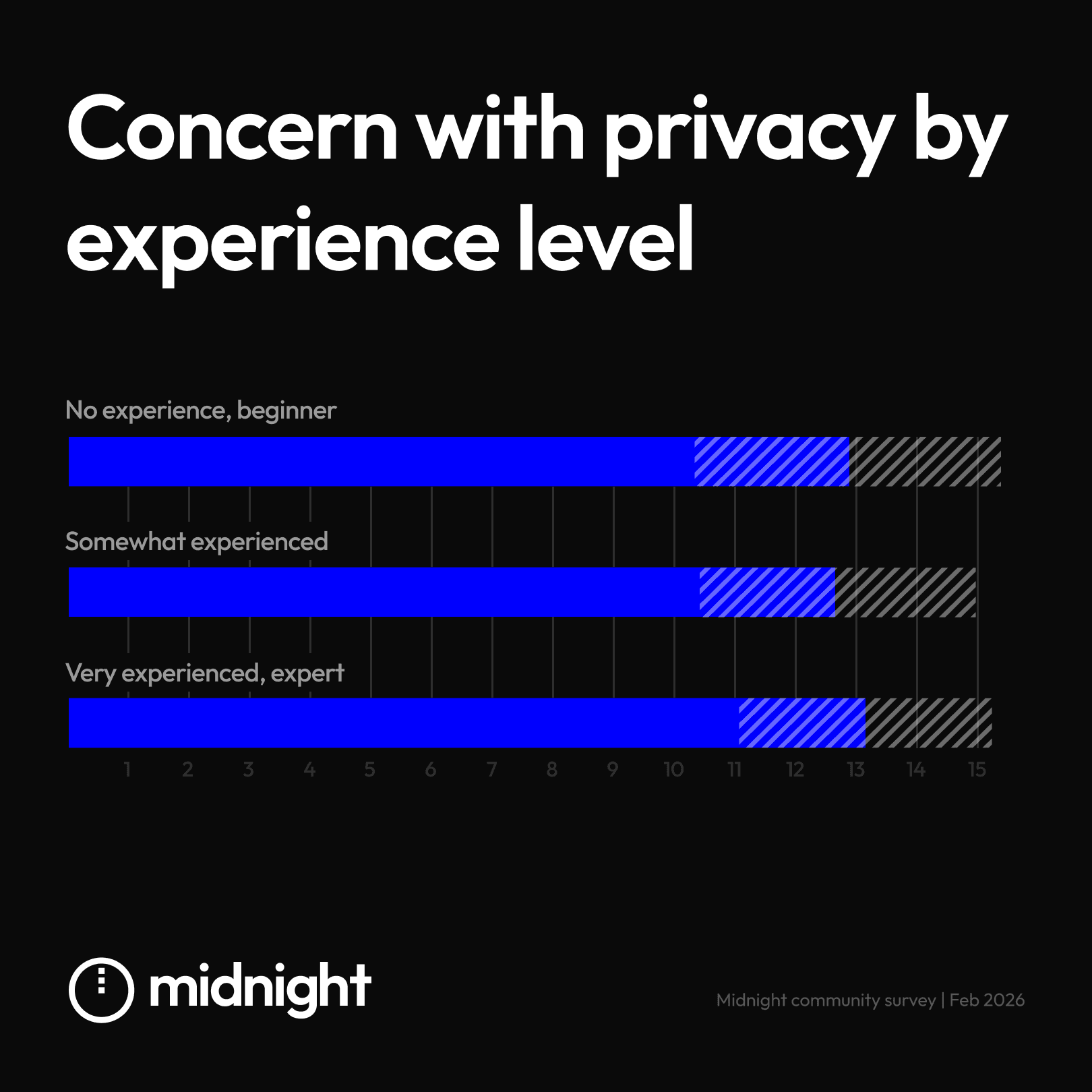
The consensus on privacy transcends technical ability. The community research results indicate that beginners, experts, and developers place nearly equal emphasis on the importance of data protection, with negligible scoring differences between novices and power users. This confirms that privacy is a baseline expectation, not a niche interest.
This shared value may drive a self-selection bias: users and developers are drawn to Midnight because they already understand the importance of privacy. Yet far from being outliers, the results from the Midnight communities are largely consistent with international trends, where privacy is viewed as an essential right rather than an optional feature.
This outlook represents a major opportunity for developers. Privacy-enhancing technology can be a competitive advantage. This is where rational privacy becomes essential: it empowers developers to move beyond the binary of total transparency or total secrecy, allowing them to build applications that reflect the specific cultural and technical demands of specific applications and communities of users.
Privacy is a cross-border and cross-chain unifier. By providing tools that offer privacy-enhancing technology as the default, developers in the Midnight ecosystem can solve the privacy paradox by transforming a global demand into a functional reality.