
Privacy needs and expectations are nearly universal, transcending blockchain ecosystems and the broader global population. However, the forced transparency of public blockchains continues to restrict applications in regulated markets and institutional sectors.
To power the next generation of utility, privacy must be programmable. Midnight’s fourth-generation technology enables developers to align application design with user expectations while remaining compliant with regulatory frameworks.
Alongside the launch of the Midnight network, the Midnight Foundation is sharing these community survey results to support developers in understanding user interest and behavior. Using a data-driven approach to designing applications can help developers to differentiate their applications using programmable privacy, utility and user experience.
Current DApp usage and engagement
Understanding current DApp usage provides developers with insight into user familiarity and technical expectations. By identifying the DApps the community uses most often, builders can design applications that align with established user behaviors and expectations while introducing the unique advantages of programmable privacy.
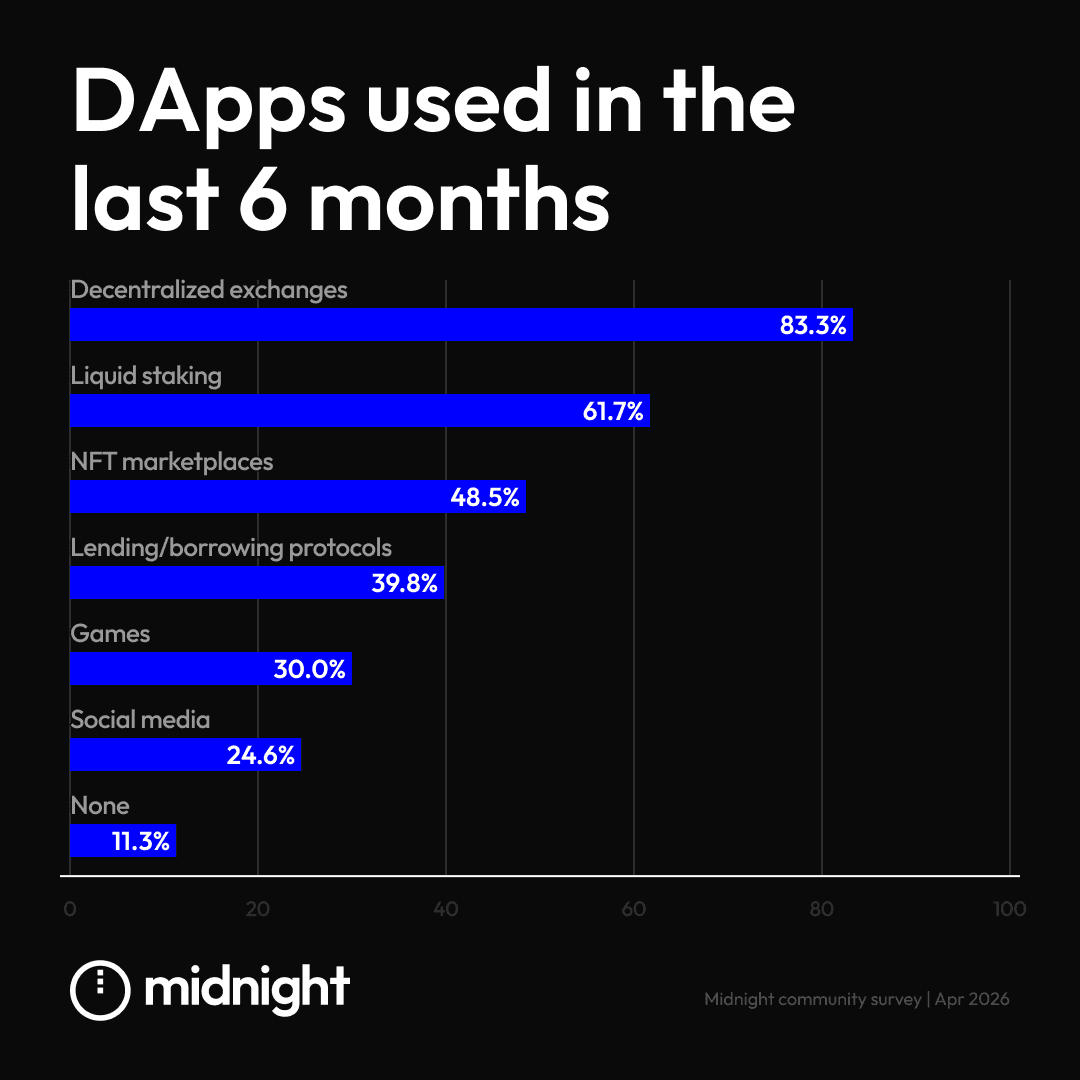
The data shows that most Midnight community members are familiar with decentralized finance (DeFi), particularly through decentralized exchanges and liquid staking. These are areas where privacy is a fundamental requirement rather than a secondary feature.
Private trading
Developers can utilize Midnight’s privacy-enhancing technology to build shielded liquidity pools and privacy-preserving exchanges. In these applications, order size, execution timing, and trading strategies can remain hidden from the public ledger. Transactions can be matched and settled without signaling market intent.
Gaming and Social
Beyond financial transactions, many users also report participation in blockchain-based gaming (29.5%) and social media applications (24.1%).
Usage patterns across these categories reveal significant differences in user history. Community members who engage with multiple types of DeFi and blockchain-based gaming tend to be the most experienced ecosystem participants, reporting a longer history of blockchain-based activity. Conversely, those using decentralized social media platforms are frequently the newest entrants to the blockchain space, with many having only initiated their first blockchain interactions within the last few years.
While designing intuitive and user-friendly interfaces is highly recommended for all applications, developers can adjust their technical assumptions based on these attributes of different DApp users. Builders focusing on social media or general consumer applications should assume less familiarity with standard blockchain UX flows and mechanisms. These users may be less accustomed to typical wallet interactions or transaction signing. Prioritizing simplicity, intuitive user experience and removing technical friction is even more important for successful adoption with these types of applications.
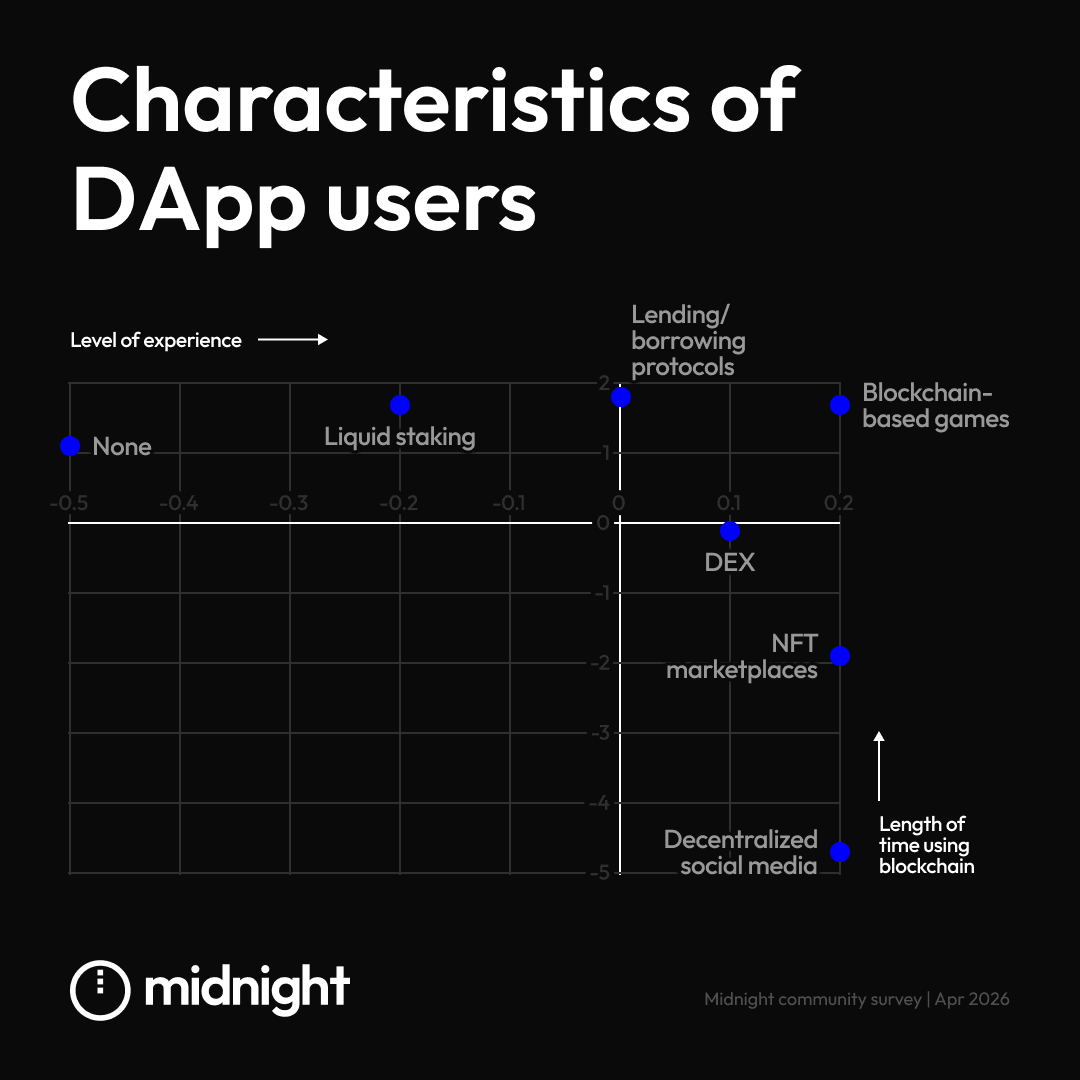
The chart above identifies the average characteristics of individuals who have used specific DApp categories over the past six months. Data points represent the difference between the DApp user mean and the sample mean for two variables: technical experience (rated 1–5) and years since their first blockchain transaction.
Predicting the next wave of growth
The community identifies significant potential for Midnight to address current industry needs. When asked which areas would see the most growth, respondents focused heavily on real-world assets (RWAs), DeFi and privacy.
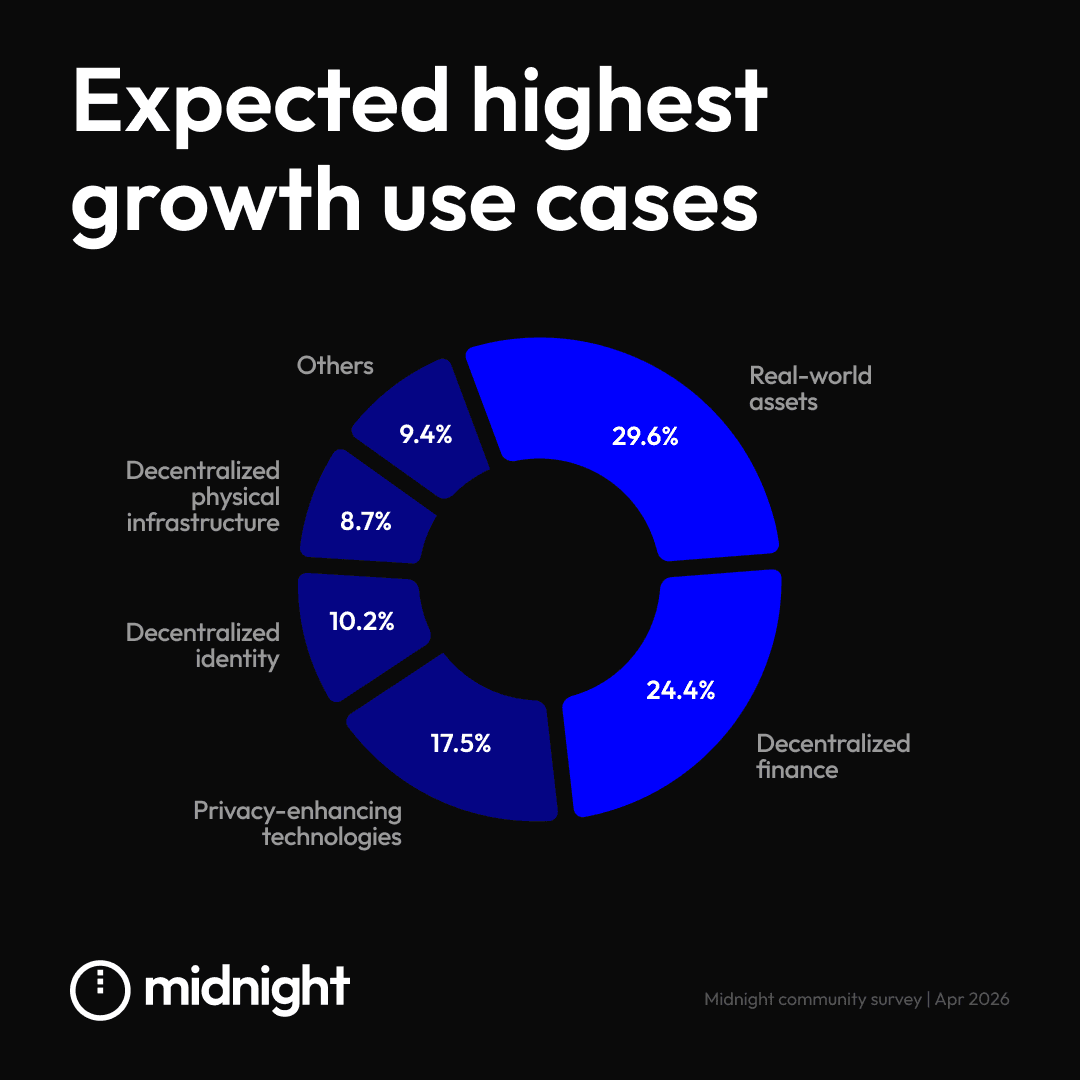
Combined, over 50% of respondents thought RWAs and DeFi would see the most growth.
Developers are more likely than the general community to predict growth in privacy-enhancing technologies (27%) and decentralized identity (15%).
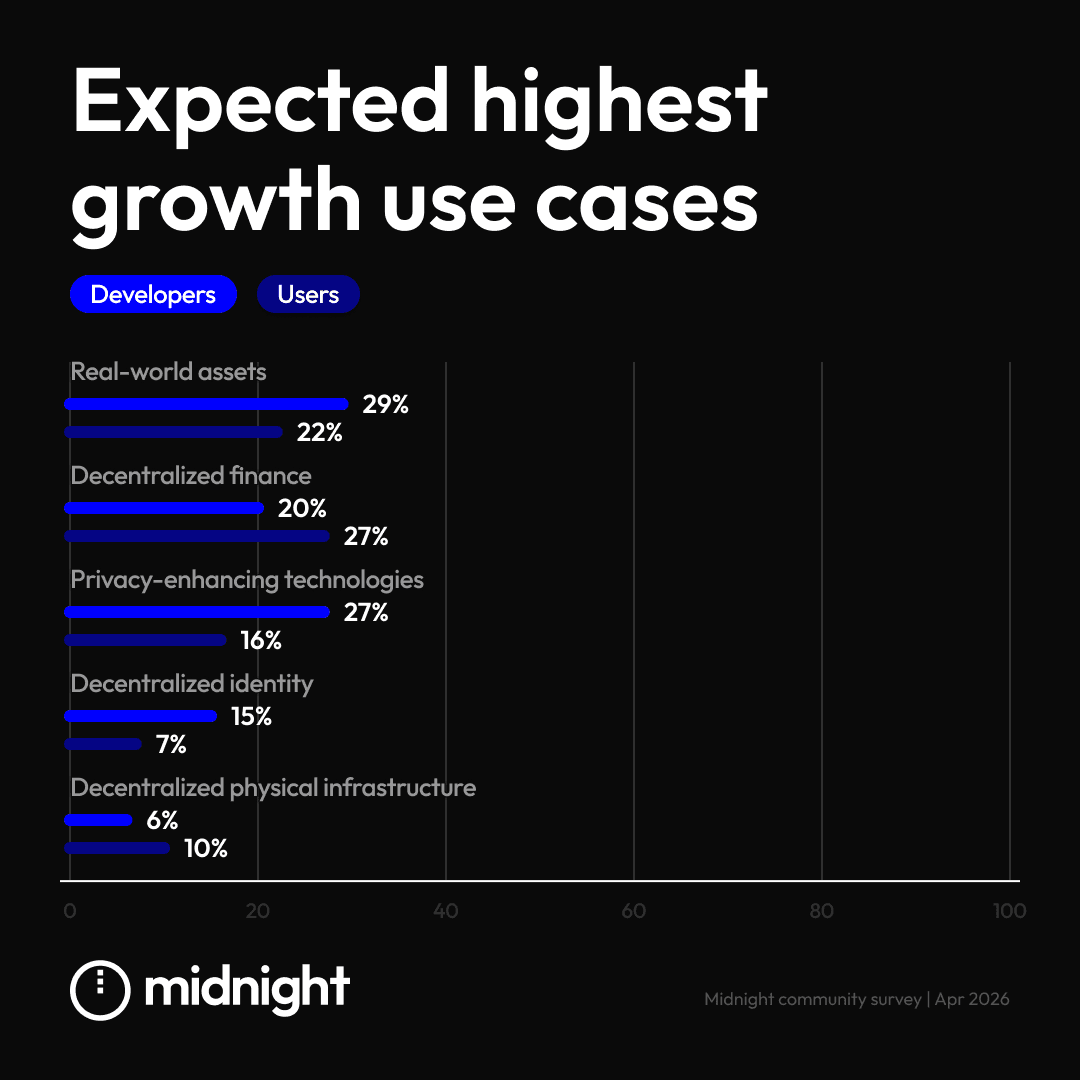
The overarching themes of the community survey reveals a fundamental component of user expectations: the demand for better privacy is not a call for a wider range of privacy settings, but for better privacy outcomes. This emphasizes for developers the importance of communicating the privacy-enhancing features of DApps.
While developers can focus on the technical "how" of implementing privacy-enhancing technologies, users want simple and intuitive methods of securing their data without requiring constant and complex manual oversight. Users value privacy but often abandon tools that impose a heavy cognitive or operational burden in the form of complex privacy settings.
Most exciting Midnight use cases
The community survey also asked respondents to identify which specific Midnight features they are most excited about.
Responses convergence between developers and users regarding the most compelling Midnight use cases. Both groups rank potential applications in a similar order of interest.
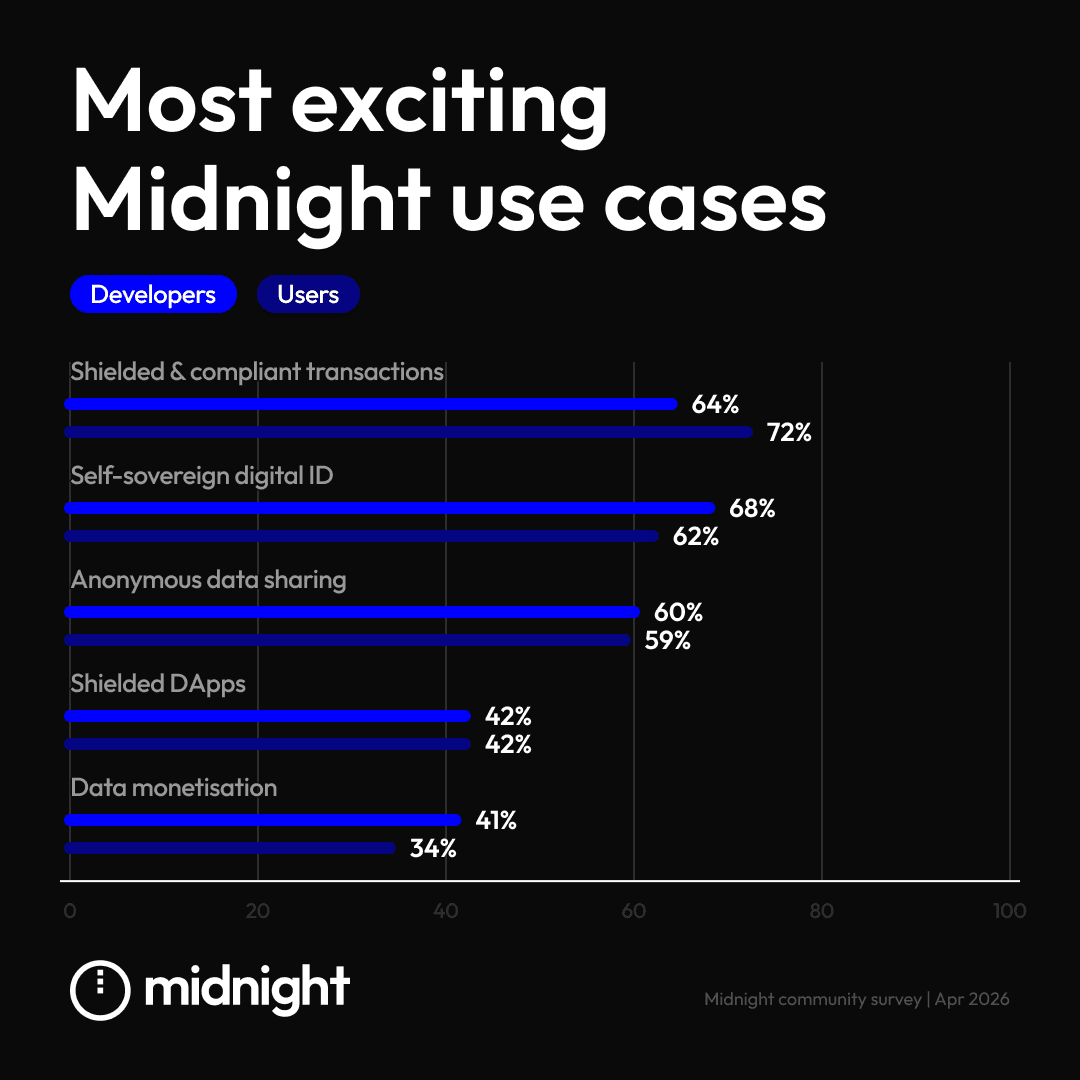
Users report even higher levels of excitement for shielded transactions than developers. This reinforces the need for builders to actively promote the privacy-enhancing features of their products. Developers who clearly and concisely communicate their private-by-design features will be better positioned to differentiate their applications to users.
Privacy and monetization overlap
Another useful insight from the community research is the crossover in interest for features that provide transaction privacy and data monetization. Analysis of the overlap between these interests reveals a clear priority: privacy is a prerequisite for monetization.
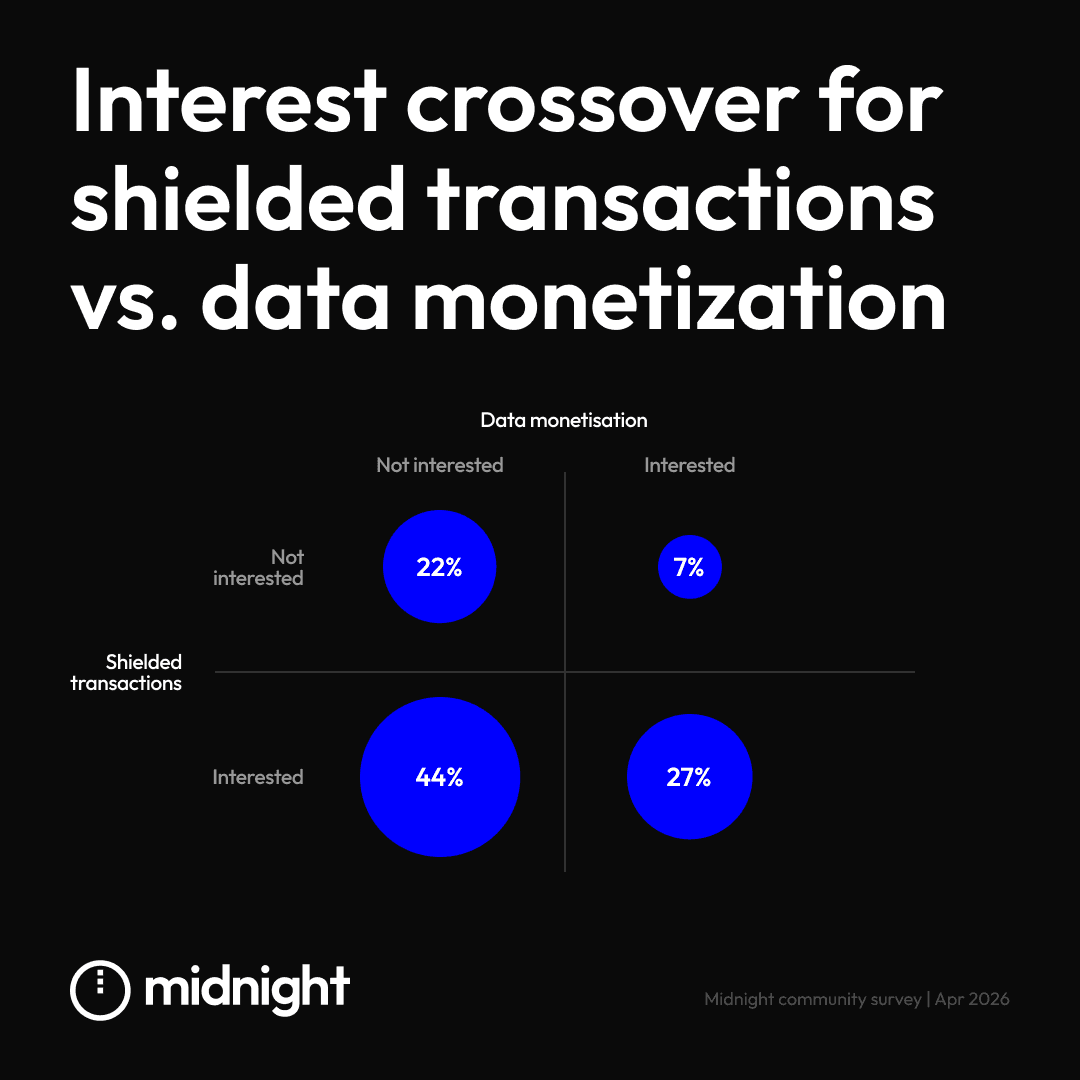
The data shows that interest in data monetization is rarely independent of a desire for privacy. Only 7% of users show an interest in monetizing their data without shielded transactions, while 27% are interested in both shielded transactions and monetization. For most users who would monetize their data, preserving privacy is also important.
Furthermore, 44% of respondents who are excited about shielded transactions do not indicate an interest in monetizing their data.
These findings provide additional evidence supporting the importance for DApp users of keeping privacy as the default state. Because the majority of users interested in monetization also demand data protection, developers must establish robust privacy as the foundational layer.
Privacy and utility
The survey results confirm that the Midnight community views privacy not as a standalone feature, but as a foundational component of the next generation of DApps. From RWAs to digital identity, the demand for programmable privacy is clear.
The Midnight Foundation continues to support the development of the tools and infrastructure necessary to turn expectations into practical applications.
The community also deserves a special thanks for participating in this research. These are extraordinarily helpful in shaping the development of applications on Midnight. Please continue to share feedback, insights and thoughts as the network and community continues to evolve.
To stay informed on the latest developments and jump into the discussion, join the Midnight community on Discord.